Julien Coulon Passerelles

from €12.00

Looking Back in Time

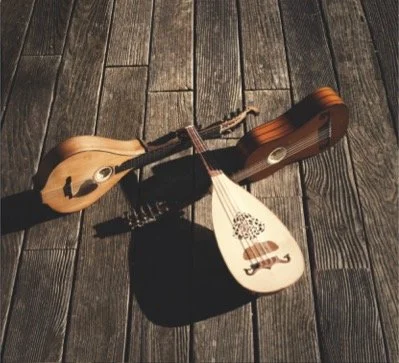
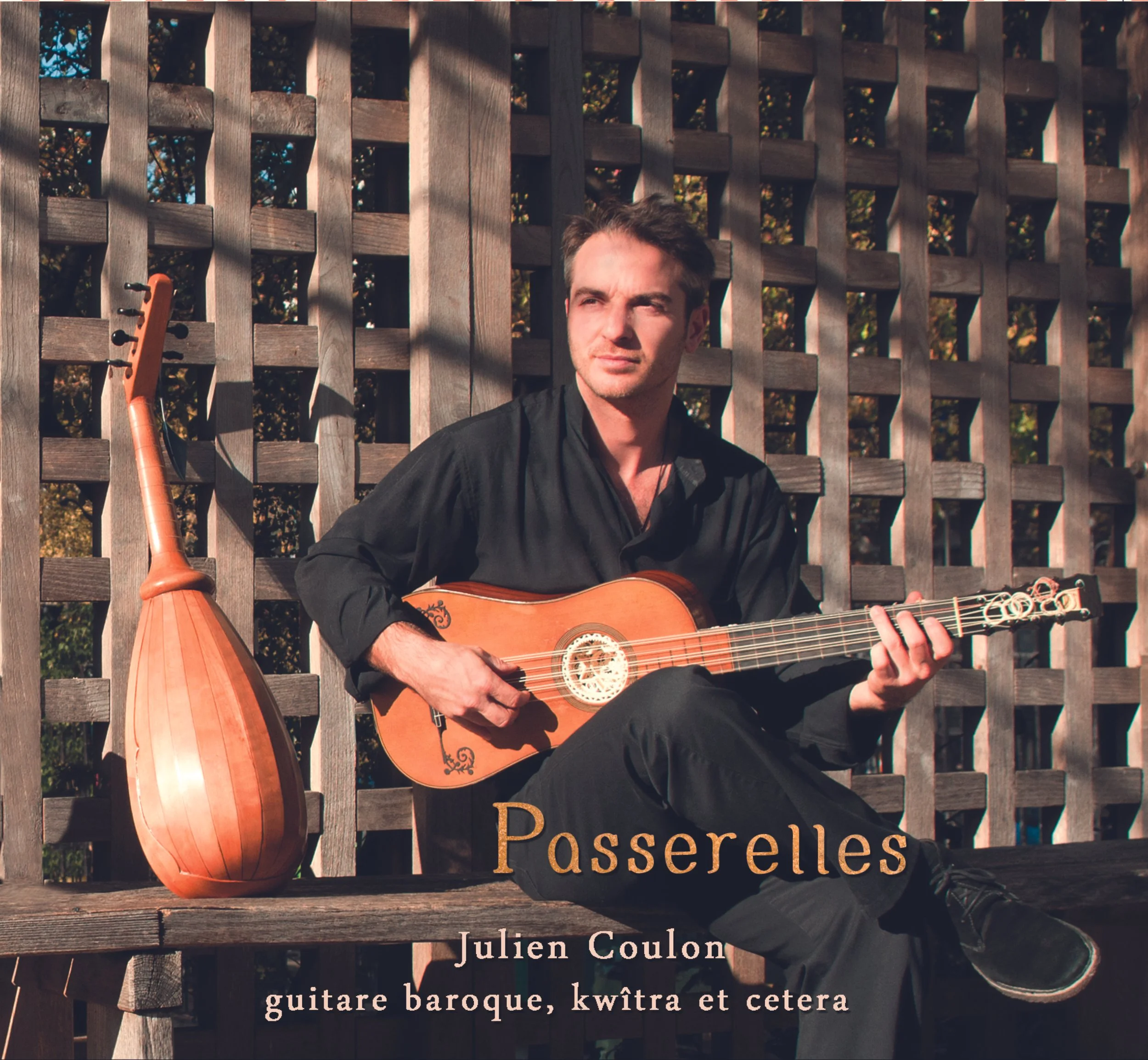
On my first album (Par-delà les Nuages / Beyond the Clouds), I use three instruments representing the three families of instruments I play: the classical guitar, the oud (oriental lute), and the laúd (Spanish cittern). Despite some very old pieces, that first album is resolutely rooted in 20th-century music while echoing the past; with Passerelles, it's the opposite. This recording references the 17th century, and engages with our time through the juxtaposition of Baroque and contemporary pieces. To achieve this, I again play three instruments, the "ancestors" of those used in Par-delà les Nuages: the Baroque guitar, the kwîtra (Algerian lute), and the cetera (Corsican cittern). The repertoire is primarily centered around the works of Gaspar Sanz (1640-1710), an eminent Spanish guitarist and composer of the Baroque era, supplemented by Sephardic, Italian, Turkish, Greek, Provençal, and Egyptian pieces. A true journey through time and space in the Mediterranean three centuries ago, these musical pieces, mostly derived from folk tunes and dances, challenge our memory and allow us to (re)discover the musical heritage of yesteryear, like bridges extending to other times and other cultures...

Thank you

To Christine for her presence and indispensable support, to Benoît for his loyalty and exceptional expertise, to Marianne for her patience and invaluable artistic qualities, to Emmanuel for once again enthusiastically taking on the role of co-producer, to Pascal-Edouard for facilitating the financial coordination of this project through the Zéfir association, to Béranger, Philippe, and Ugo for crafting fabulous instruments, to Elena for creating marvelous rosettes, and to my family and friends for always being there when needed.

To Madame Le Bail for opening the doors of the Musée des Avelines to us, to Madame de Larminat for authorizing this recording in Saint-Cloud, to Madame Guichard for coordinating this project with such energy, and to Madame Cabos for her kind welcome.

I dedicate this album to Elora and Gaspard, my two little angels.

In memory of my friend Yves Béretta, who passed away on August 5, 2014.

Album recorded on October 27 and 28, 2014 at the Musée des Avelines in Saint-Cloud.
Benoît Laur/sound recording, editing, mixing and mastering

Marianne Kuhn/photography and graphic design

Béranger Griot/baroque guitar (Paris, 2008)
Philippe Rik/kwîtra (La Chapelle-Rablais, 2012)
Ugo Casalonga/cetera (Pigna, 1990)
Elena Dal Cortivo/rosettes (guitar and cetera)

Format:

Looking Back in Time

On my first album (Par-delà les Nuages / Beyond the Clouds), I use three instruments representing the three families of instruments I play: the classical guitar, the oud (oriental lute), and the laúd (Spanish cittern). Despite some very old pieces, that first album is resolutely rooted in 20th-century music while echoing the past; with Passerelles, it's the opposite. This recording references the 17th century, and engages with our time through the juxtaposition of Baroque and contemporary pieces. To achieve this, I again play three instruments, the "ancestors" of those used in Par-delà les Nuages: the Baroque guitar, the kwîtra (Algerian lute), and the cetera (Corsican cittern). The repertoire is primarily centered around the works of Gaspar Sanz (1640-1710), an eminent Spanish guitarist and composer of the Baroque era, supplemented by Sephardic, Italian, Turkish, Greek, Provençal, and Egyptian pieces. A true journey through time and space in the Mediterranean three centuries ago, these musical pieces, mostly derived from folk tunes and dances, challenge our memory and allow us to (re)discover the musical heritage of yesteryear, like bridges extending to other times and other cultures...

Thank you

To Christine for her presence and indispensable support, to Benoît for his loyalty and exceptional expertise, to Marianne for her patience and invaluable artistic qualities, to Emmanuel for once again enthusiastically taking on the role of co-producer, to Pascal-Edouard for facilitating the financial coordination of this project through the Zéfir association, to Béranger, Philippe, and Ugo for crafting fabulous instruments, to Elena for creating marvelous rosettes, and to my family and friends for always being there when needed.

To Madame Le Bail for opening the doors of the Musée des Avelines to us, to Madame de Larminat for authorizing this recording in Saint-Cloud, to Madame Guichard for coordinating this project with such energy, and to Madame Cabos for her kind welcome.

I dedicate this album to Elora and Gaspard, my two little angels.

In memory of my friend Yves Béretta, who passed away on August 5, 2014.

Album recorded on October 27 and 28, 2014 at the Musée des Avelines in Saint-Cloud.
Benoît Laur/sound recording, editing, mixing and mastering

Marianne Kuhn/photography and graphic design

Béranger Griot/baroque guitar (Paris, 2008)
Philippe Rik/kwîtra (La Chapelle-Rablais, 2012)
Ugo Casalonga/cetera (Pigna, 1990)
Elena Dal Cortivo/rosettes (guitar and cetera)

The album in depth

Preludio & Sesquialtera, Españoletas, Canarios, and Folias are pieces written by Gaspar Sanz (1640-1710) in his Instruccion de Musica sobre la Guitarra Española (1674-1675), a major reference work on Baroque guitar music. This accomplished composer, guitarist, and lutenist, who was also a priest, was the music teacher of Don Juan of Austria.

Layla is a song written in the 1950s by Farid El Atrach (1915-1974), a leading figure in 20th-century Arabic music, who was a singer, lutenist, composer, and actor.

Canario is a piece for theorbo by Johannes Kapsberger (c. 1580–1651), a Venetian composer, lutenist, and theorbo player of German origin, followed by Le Petit Riens, an air from the dance treatise written in 1463 by Giovanni Ambrosio (c. 1420–1484), an Italian dance master and choreographer at the court of Lorenzo de' Medici.

A la una yo naci and Aman minoush are two romances from the Sephardic repertoire. Following the Reconquista led in 1492 by Isabella of Castile, the Jews of Spain (literally "Sephardic") were expelled and took their songs with them throughout the Mediterranean basin.

Panorama Smyrnis is a theme originating from the rebetiko, a Greek musical genre of Turkish origin developed in the Athens slums in the 1920s. With its oriental inspiration (Smyrna being present-day Izmir), this theme is characterized by its catchy rhythm.

Moun payré avié is a traditional Provençal melody recounting the misadventures of a father and his three daughters...

Longa Chenaz is a piece from the Ottoman classical repertoire, attributed to Ethem Efendi, a Sufi master at the court of Abdül Hamid II, the last sultan of the Ottoman Empire.

Pigna is a personal tribute to this magnificent village of the same name located in Upper Corsica, where I had the pleasure of staying, and where my cetera was built by the master luthier Ugo Casalonga.