Rudolf Straube Thirty two Solo Lessons by Several Masters

from €12.00

Available as a download now - CDs coming shortly. We apologize for the delay.

Rudolf Straube was born on 5 December, 1717, southwest of Leipzig in Elsterebnitz, Saxony-Anhalt, and died in London about 1785. His father, Christian, who was a cantor, enrolled his son at the Thomassschule in Leipzig on 23 June, 1733. Rudolf sang in the choir under J.S. Bach, had private tuition from him, and eventually became a music copyist for his master. He entered the University at Leipzig on 27 February 1740, and became a lute player at the court in Köthen in 1741. 

Despite his connection to Bach, Straube was unsuccessful in bids to become an organist, and like many German musicians and instrument builders of his time, he moved to London in the second half of the 1750s, where he learned about a new instrument that was gaining in popularity: the English guittar or cetra. He was appointed as one of the music masters to Queen Charlotte, who played the cetra, and dedicated his set of keyboard variations, The Mecklenburgh Gavotte, to her. 

Straube’s Thirty two Solo Lessons is the final section of his large collection Three Sonatas for the Guittar…, published by the music seller, publisher and instrument builder Michael Rauche in London in 1768. Straube was a professional lutenist in the style of Sylvius Leopold Weiss or Adam Falkenhagen, whose Rondeau from Six Partitas For Solo Lute, Op.2 (1742) Straube arranged. His compositions and arrangements for cetra or guittar are some of the most advanced for the instrument. Unlike the cetra music of Francesco Geminiani (CETRA002), which is also among the best in the repertoire, but which at times seems influenced by Geminiani’s prodigious violin technique, Straube’s cetra music is perfectly idiomatic, and often features two voices, as with the lute, thus setting him apart from most other composers and arrangers for cetra.

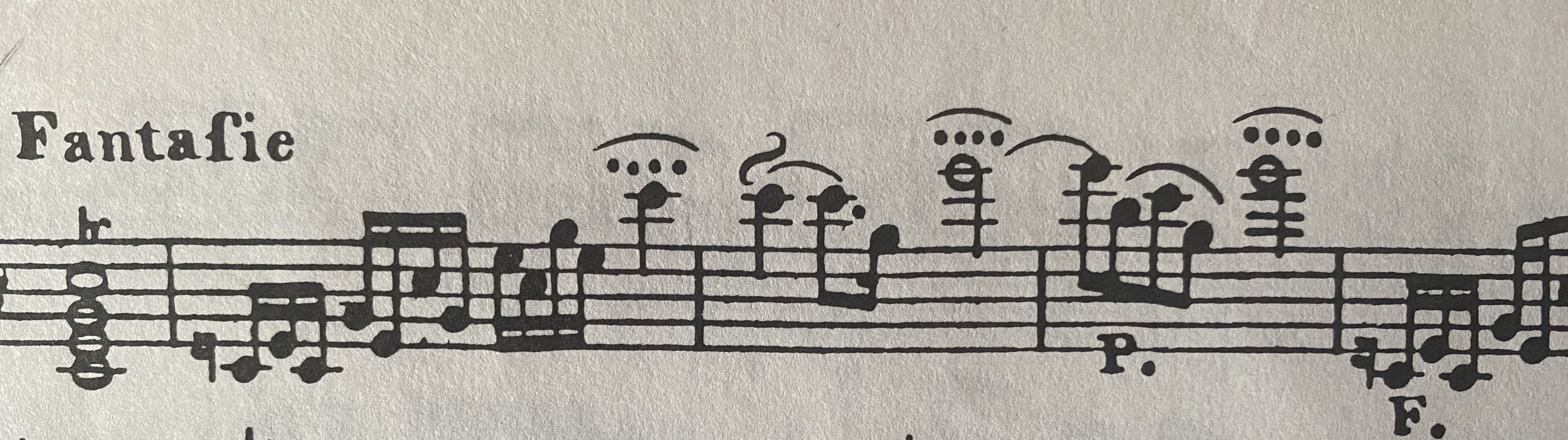
Another trait that sets Straube apart is his use of a variety of ornament or grace signs, in addition to the ubiquitous trill or shake. In her Lessons and Instructions for Playing on the Guitar (1760), Ann Ford describes the wide variety of graces current at the time, based on the work of Thomas Mace in Musick’s Monument (1676), still respected and revered a century later, as it remains to this day. Although the trill or shake sign dominates in Straube’s book, he also uses a different sign for the turn, as well as another, unique to him as far as I can tell (see photo). This sign does not appear in tables of graces for plucked instruments, but it does resemble the sign used at that time for flutter tonguing on wind instruments. I have interpreted it to indicate vibrato, or what Ford calls the Swell, as its placement by Straube fits her description:

The Swell is a very fine Grace, and what can be instantly learnt, and should never be omitted in very slow Movements, or where you dwell on a stop Note. Suppose, for Instance, D is the Note you are to Swell, stop it very close down to the fret, and give it a full Tone with your Right-hand Finger; so soon as that is done, draw the string towards the Ball of your Left-hand, pressing it hard all the while, and thus rubbing it backwards and forwards on the Fret, the Tension of the String will be encreased, and causes a fine cromatic Swell: But before you take your Finger off, you must let the String come to its proper Tone, otherwise the intended Grace wil become unharmonious. (5-6)

In these performances, I have endeavored to use a variety of graces in an attempt to emulate the playing of a professional lutenist like Straube, suiting the grace to the note or phrase in question, including the tut, beats, falls, piano and forte, the fermata or pause, and changing the timbre by moving the right hand nearer to or farther from the bridge, all of which are described by Mace and Ford.

Like the Pastorales and Minuets he seems so fond of, the music Rudolf Straube composed and arranged for cetra is restrained, graceful and stately, whether it be a simple and jaunty Paysane or Giga, a complex Fantasie or Largo, or a prolonged Tempo di Minuet. His music is full of color and contrast, replete with rising thirds, cascading sixths, sustained chords, arpeggios, figuration, variation, and both rhythmic and dynamic vigor.

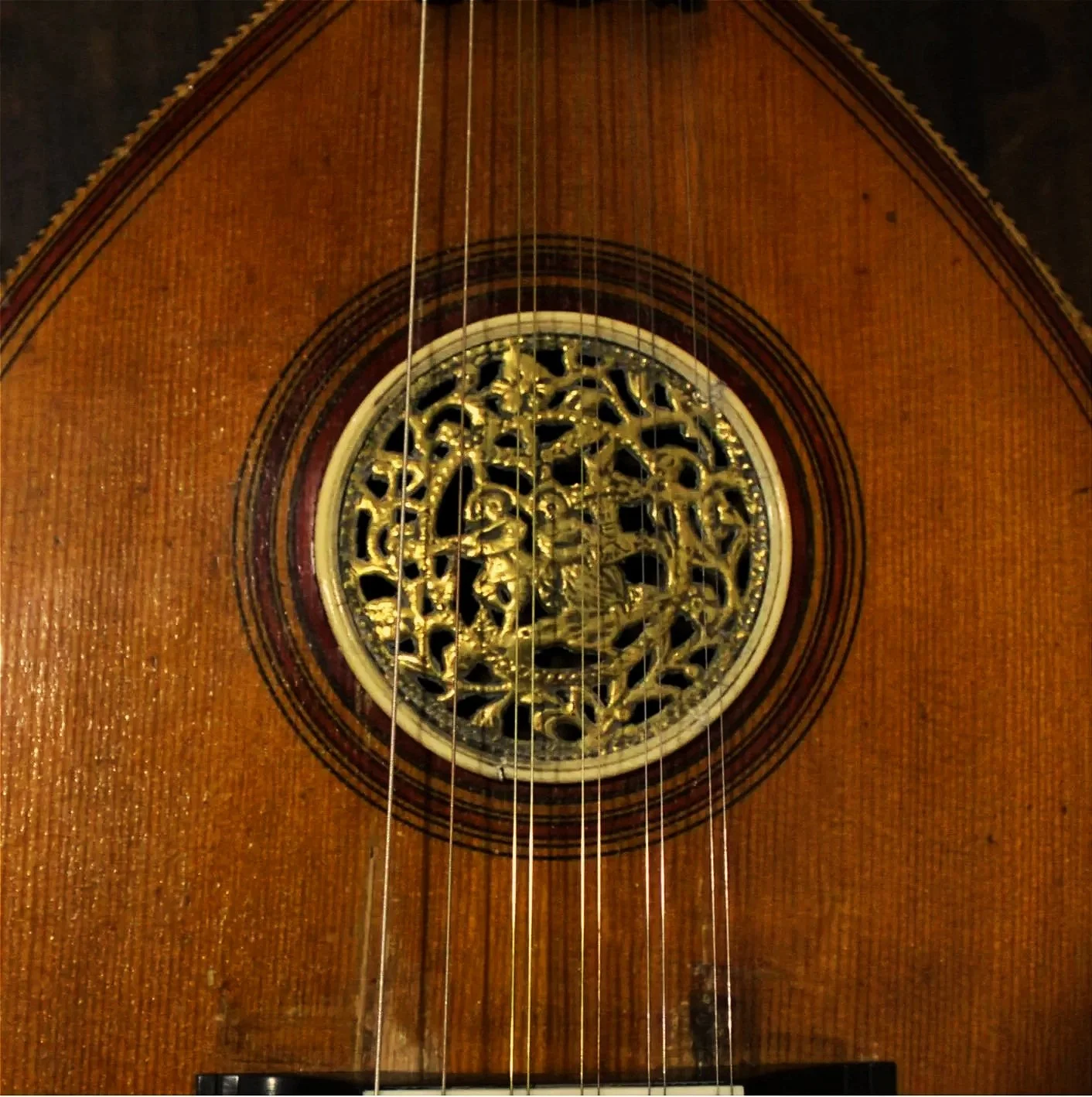
Playing and recording with an original 18th-century instrument is at once exciting and frustrating. They’re delicate, finicky, perhaps not fretted to modern standards, but they give us a direct link to the music that we record on them, and for all of their quirks, and the many challenges they present, occasionally they can sound great. The Longman & Broderip cittern that I play on this recording was built at about the same time that Straube published his book of cittern music. The instrument has not been restored, but rather has been repaired and made playable by master violeiro [builder] Diogo Valente. I want to acknowledge and thank Diogo for his impeccable work on this instrument, and for all of the work he has done on my collection of original instruments, not forgetting the beautiful instruments he has built for me. [See Geminiani and Rush]

Format:

Available as a download now - CDs coming shortly. We apologize for the delay.

Rudolf Straube was born on 5 December, 1717, southwest of Leipzig in Elsterebnitz, Saxony-Anhalt, and died in London about 1785. His father, Christian, who was a cantor, enrolled his son at the Thomassschule in Leipzig on 23 June, 1733. Rudolf sang in the choir under J.S. Bach, had private tuition from him, and eventually became a music copyist for his master. He entered the University at Leipzig on 27 February 1740, and became a lute player at the court in Köthen in 1741. 

Despite his connection to Bach, Straube was unsuccessful in bids to become an organist, and like many German musicians and instrument builders of his time, he moved to London in the second half of the 1750s, where he learned about a new instrument that was gaining in popularity: the English guittar or cetra. He was appointed as one of the music masters to Queen Charlotte, who played the cetra, and dedicated his set of keyboard variations, The Mecklenburgh Gavotte, to her. 

Straube’s Thirty two Solo Lessons is the final section of his large collection Three Sonatas for the Guittar…, published by the music seller, publisher and instrument builder Michael Rauche in London in 1768. Straube was a professional lutenist in the style of Sylvius Leopold Weiss or Adam Falkenhagen, whose Rondeau from Six Partitas For Solo Lute, Op.2 (1742) Straube arranged. His compositions and arrangements for cetra or guittar are some of the most advanced for the instrument. Unlike the cetra music of Francesco Geminiani (CETRA002), which is also among the best in the repertoire, but which at times seems influenced by Geminiani’s prodigious violin technique, Straube’s cetra music is perfectly idiomatic, and often features two voices, as with the lute, thus setting him apart from most other composers and arrangers for cetra.

Another trait that sets Straube apart is his use of a variety of ornament or grace signs, in addition to the ubiquitous trill or shake. In her Lessons and Instructions for Playing on the Guitar (1760), Ann Ford describes the wide variety of graces current at the time, based on the work of Thomas Mace in Musick’s Monument (1676), still respected and revered a century later, as it remains to this day. Although the trill or shake sign dominates in Straube’s book, he also uses a different sign for the turn, as well as another, unique to him as far as I can tell (see photo). This sign does not appear in tables of graces for plucked instruments, but it does resemble the sign used at that time for flutter tonguing on wind instruments. I have interpreted it to indicate vibrato, or what Ford calls the Swell, as its placement by Straube fits her description:

The Swell is a very fine Grace, and what can be instantly learnt, and should never be omitted in very slow Movements, or where you dwell on a stop Note. Suppose, for Instance, D is the Note you are to Swell, stop it very close down to the fret, and give it a full Tone with your Right-hand Finger; so soon as that is done, draw the string towards the Ball of your Left-hand, pressing it hard all the while, and thus rubbing it backwards and forwards on the Fret, the Tension of the String will be encreased, and causes a fine cromatic Swell: But before you take your Finger off, you must let the String come to its proper Tone, otherwise the intended Grace wil become unharmonious. (5-6)

In these performances, I have endeavored to use a variety of graces in an attempt to emulate the playing of a professional lutenist like Straube, suiting the grace to the note or phrase in question, including the tut, beats, falls, piano and forte, the fermata or pause, and changing the timbre by moving the right hand nearer to or farther from the bridge, all of which are described by Mace and Ford.

Like the Pastorales and Minuets he seems so fond of, the music Rudolf Straube composed and arranged for cetra is restrained, graceful and stately, whether it be a simple and jaunty Paysane or Giga, a complex Fantasie or Largo, or a prolonged Tempo di Minuet. His music is full of color and contrast, replete with rising thirds, cascading sixths, sustained chords, arpeggios, figuration, variation, and both rhythmic and dynamic vigor.

Playing and recording with an original 18th-century instrument is at once exciting and frustrating. They’re delicate, finicky, perhaps not fretted to modern standards, but they give us a direct link to the music that we record on them, and for all of their quirks, and the many challenges they present, occasionally they can sound great. The Longman & Broderip cittern that I play on this recording was built at about the same time that Straube published his book of cittern music. The instrument has not been restored, but rather has been repaired and made playable by master violeiro [builder] Diogo Valente. I want to acknowledge and thank Diogo for his impeccable work on this instrument, and for all of the work he has done on my collection of original instruments, not forgetting the beautiful instruments he has built for me. [See Geminiani and Rush]

The album in depth

Fantasie Moderato by Straube・Largo by Straube・Rondeau by Straube The solos begin with a thoughtful Fantasie composed of contrasting phrases that show the range of colors and effects the small, wire-strung cetra is capable of. Straube indicates several different graces in the score - trills, turns, appoggiature, fermata, vibrato, piano and forte - and I have taken this as a clue as to how the remainder of the solos should be approached.  The Fantasie is followed by a lovely, melodic Largo in the style of the German baroque lute, followed in turn by a sprightly Rondeau in the same style. Although all three pieces are marked “by Straube”, the Rondeau is based on one in Adam Falkenhagen’s Six Partitas For Solo Lute, Op.2 (1742).

Minuet Alternat 1 & 2 in F Straube includes a number of pieces in F, perhaps the second most common key for a cetra tuned in C. This pairing follows the da capo form typical of Baroque practice in that a second complete Minuet follows the first (here in the same key), the cycle ending with a recap of the first Minuet, without repeating its 10-bar strains. Poised and carefully paced, these two pieces display similar structural characteristics.

Menuet・Polonoise・Allegro The Polonoise, or Polonaise, is a Polish walking dance similar in rhythm to the Swedish Polska.

Minuet Straube used several different forms for the many minuets in his collection. This one is ternary.

Pastorale・Minuet・Hornpipe・Minuet The Pastorale is described as a slow tarantella, built on a melody in thirds over a drone. It recalls the Christmas music of Italian pastori (shepherds) played on a small double-reed pipe called a piffero, and a large bagpipe called the zampogna. The Hornpipe was a popular country dance for couples as well as a solo step dance. Originally in triple time, it eventually evolved into common time, as in this piece.

Paysane A “peasant” dance to which I have added a variation in triplets.

Menuet Alternat 1 & 2 This pair of Menuets contrasts the unaccompanied melody of the first, typical of so many cetra arrangements, with a fully developed accompaniment in the second. As a further variation, this da capo set ends with the first section of the second menuet.

Allegro by Straube Another piece in F, the many contrasting strains gallop along in 6/8 offering several opportunities for changes in tone and ornamentation.

Pastorale・Minuet by Straube This lovely Pastorale is followed by Straube’s own minuet, which is built on an 8-bar strain with open and closed endings, and a contrasting strain in the B music before returning to the main theme.

Pastorale・Minuet・Giga With its consistent second voice, this Pastorale is the most harmonically developed in the collection. The Minuet, although the simplest in structure, has one of the most elegant melodies, while the Giga is very like a tarantella. This suite is a study in different way of playing two voices.

Pastorale・Largo・Allegretto・Menuet This extended Pastorale includes a contrasting and very quiet Largo section, before moving on to a slightly faster Allegretto, as if one were listening to the pastori moving through the village while collecting alms for Christmas. The Menuet presents variations rather than a second piece before returning to the main theme.

Country Dances Six country dances of varying lengths in 2/4 and 6/8.

Largo by Straube This Largo is really another fantasie, presenting a variety of contrasting strains and motifs, as in the opening piece, but this time in the key of F.

Tempo di Minuet by Straube The final piece in Straube’s collection of sonatas, songs and solos “Properly adapted” for the “Guittar” or 18th-century cittern, is almost like another fantasie, though more structured and in ternary form. It’s a wonderfully expressive piece that, as with his other compositions, gives us a glimpse into the musical mind of this maestro of the galant style.